

Intellectual Property
Specialised IP advice that does not sit in a silo. Your brands, content and inventions are commercial assets, and we treat them as part of the wider picture, protected, owned correctly and ready to be licensed or sold.
Protecting your IP
Trade marks, copyright, designs and confidential know-how, identifying what you own and making sure ownership is clear and secure.
IP in your contracts
Assignments, licences and the IP terms inside your commercial agreements, so rights end up where they should.
Joined up with the rest
IP advice that connects to your commercial, corporate and dispute work, rather than being bolted on afterwards.
What is an IP audit?
An IP audit is a systematic review of the intellectual property a business owns, uses, or has created, to assess risk, find gaps, and help you make informed decisions about what to protect.
Think of it like a stocktake before an audit. You cannot manage what you do not know you own.
Stocktake
A structured inventory of everything the business owns, registered or not.
Gap finder
Identifies what is unprotected and what needs action.
Action plan
The goal is a clear, prioritised plan, not just a document.
Five types of IP audit, which one fits your business?
| Audit type | Right for | Scope | How we charge |
|---|---|---|---|
| Trade Mark Audit | Business with a brand but no TM strategy | Trade marks + high-level IP flags | Fixed fee, offset against filing |
| Full IP Audit | Pre-scale, restructure, or first IP strategy | All IP categories + agreements | Fixed fee, offset against filing |
| IP Due Diligence | Deal, investment, or acquisition | Event-defined scope | Fixed fee, standalone |
| Limited Purpose Audit | One specific question, fast turnaround | Single issue only | Fixed fee, standalone |
| Annual Trade Mark MOT | Existing registered portfolio | Use review + renewals + roadmap | Annual subscription |
The audit fee is credited against filing costs if you instruct us within 90 days of the report.
Already have a registered portfolio? See the Annual Trade Mark MOT.
Eight triggers that mean you need an IP audit now
Starting out
No IP mapped. A Trade Mark Audit establishes your baseline.
Acquiring a business
Check the target owns what it claims to own.
Expanding into new markets
Trade mark protection is territorial. Check you're covered where you trade.
A key person is leaving
Was IP created by that person properly assigned to the business?
Raising investment
Investors carry out IP due diligence. A clean IP position strengthens your case.
Launching a new product or brand
Check clearance before committing to the name or logo.
Licensing or franchising
Confirm ownership before granting rights to a third party.
Annual good housekeeping
The MOT keeps existing portfolios current and renewal-safe.
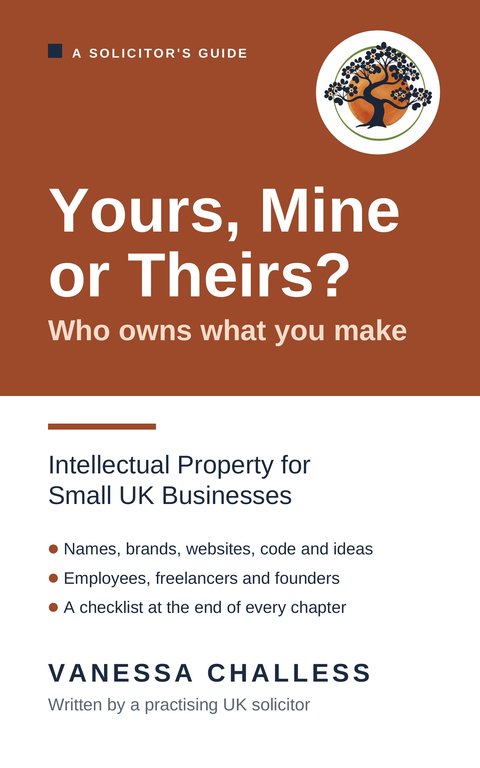
The book
Yours, Mine or Theirs?
Intellectual Property for Small UK Businesses, by Vanessa Challess
A plain-English guide to what your business owns, how to keep it, and when you need a lawyer. Every chapter ends with a checklist and the legal sources.
Common questions
A trade mark is a sign that distinguishes your goods or services from those of other businesses, a word, logo, slogan, shape, colour, sound, or combination. A registered trade mark gives you the exclusive right to use that mark in the UK for the goods and services specified in the registration, and the right to prevent others from using the same or confusingly similar marks. For SMEs, trade marks are among the most commercially significant assets you can own, without registration, someone else can register a similar mark and legitimately demand that you stop using your own brand, sometimes after you have invested significantly in building it.
Registration is handled by the UK Intellectual Property Office (UKIPO) in five stages: (1) clearance search, checking for earlier conflicting marks; (2) application, filing with a clear representation of the mark and a specification of goods and services it will cover; (3) examination, the UKIPO examines the application, typically within two months, and may raise objections; (4) publication, if accepted, published for a two-month opposition period; (5) registration, if no opposition is filed, the mark is registered. UK trade mark registrations are valid for ten years and renewable indefinitely. Current UKIPO fees: £170 for the first class, £50 per additional class.
A clearance search checks whether your proposed mark is free to use and register, identifying earlier registered marks that might block your application or expose you to an infringement claim, and unregistered marks that could give rise to passing off claims. Skipping the clearance step is one of the most expensive mistakes growing businesses make. Rebranding after a significant marketing investment almost always costs more than the clearance search and registration combined. Clearance should happen before a name or logo is committed to publicly, ideally before a branding agency is briefed.
Trade mark infringement occurs when someone uses, without consent, a sign that is identical or similar to your registered trade mark in relation to identical or similar goods or services, where there is a likelihood of confusion. Options where your registered trade mark is being infringed include: a cease and desist letter (often effective where the infringer is unaware of your registration); a negotiated settlement; UKIPO opposition or invalidity proceedings (where the infringer holds a conflicting registration); and court proceedings for injunctions, damages, or an account of profits. The appropriate route depends on the strength of the infringement, the value at stake, and the commercial relationship with the other party.
Passing off is the common law action protecting unregistered trade marks and brand goodwill. To succeed, you must establish three elements: goodwill in your business or product; a misrepresentation by the defendant causing confusion; and damage to your goodwill. The practical difference: registered trade mark infringement is a property right, you can stop someone using a similar mark without proving actual confusion or damage. Passing off requires you to prove goodwill, confusion and damage, which is significantly harder and more expensive. For businesses with real brand recognition but no registration, passing off remains available, but registration is always the more reliable and cost-effective route.
A UK trade mark registration covers the United Kingdom only. The main routes for international protection are: an EU Trade Mark (EUTM) covering all 27 EU member states, filed through the EUIPO; the Madrid Protocol, an international registration system allowing a single application designating multiple countries (including the UK, EU, US, Australia, China); and direct national filings in specific countries. Trade mark strategy for internationally trading businesses should be planned early, registration in key markets before launching publicly is significantly cheaper than clearing a conflict identified later.
Under UK copyright law, the author of a creative work is the first owner of copyright, unless the work is created by an employee in the course of employment. Freelancers and contractors are not employees. Unless there is a written agreement assigning the IP they create to your business, they own it, website code, brand identity, marketing copy, and software can all be legally owned by the creator, not by your company, unless the contract says otherwise. Every engagement with a freelancer or contractor should include a written IP assignment clause. Retrospective assignments can be obtained if needed but require the contractor's cooperation.
A trade mark licence is a contract under which the owner of a registered trade mark (the licensor) grants another party (the licensee) the right to use the mark, typically in a specified territory, for specified goods or services, and for a specified period. Licences are used in franchising, distribution agreements, manufacturing under licence, and joint ventures. An exclusive licence gives the licensee the sole right to use the mark in the specified territory; a non-exclusive licence permits multiple licensees simultaneously; a sole licence is exclusive between licensor and licensee, but the licensor retains the right to use the mark. Licence agreements must be carefully drafted, undefined quality control provisions, unclear territory restrictions, or ambiguous termination rights create disputes.
IP due diligence is the investor's or buyer's investigation of your IP: what you own, whether you actually own it, whether it is properly protected, and whether there are outstanding disputes or risks. Common issues include: unregistered trade marks in active commercial use; IP created by contractors without written assignment; registered marks approaching renewal that haven't been maintained; domain names registered in personal rather than company names; open source software incorporated without licence compliance; and pending disputes not disclosed. Issues discovered during due diligence are used as leverage to reduce valuation or require indemnities. Getting your IP in order at least twelve months before a planned transaction gives the best outcome.
The UKIPO filing fee is currently £170 for online filing covering one class of goods or services, plus £50 for each additional class. For most SMEs, registration in two to three classes covers the business adequately. On top of UKIPO fees, solicitor fees for the clearance search, application, and prosecution vary by firm, we provide a fixed fee quote before you instruct us. The total cost is typically modest relative to the commercial value of the protection. Set against the cost of rebranding after a conflict, or defending an infringement claim, trade mark registration is consistently one of the best-value legal investments an SME can make.
A search tells you whether a specific mark is clear to register. An audit maps everything you already own, registered and unregistered. They answer different questions. Most clients need both.
A Trade Mark Audit takes 2–4 weeks. A Full IP Audit takes 4–6 weeks. Due diligence timelines are set by the deal.
We send you a filing strategy and a separate fee proposal for any recommended work. The audit fee is credited against filing costs if you instruct us within 90 days.
Have a question that isn't here? Talk to a lawyer directly - we respond to all enquiries within one working day.
Related reading

New from Bonsai Law
The Bonsai Circle
A small, deliberately vetted network of professionals. Online for now, in-person in Kent to follow. Referrals and problem-solving in the same trusted room, in confidence.
More SME Services
Founders & Owners
A signature page for the people who carry the business personally.
Commercial Law
Contracts and trading arrangements that hold up under pressure.
Corporate Law
Structures, shareholders and governance built for growth.
Dispute Resolution
Expert corporate and commercial litigators, always in your corner.
Commercial Property
Expert support whether buying, selling, leasing or investing.
Mergers & Acquisitions
Complex deals, handled with clarity and commercial focus.
Send an enquiry
Tell us what you need.
A solicitor reads every enquiry and replies personally, usually within one working day. No call centre, no chatbot.